Questions and Answers
Do you want to know how you keep the crown dense and compact? Or are you wondering if The Willow Wand® can stand frost? Look through the frequently asked questions and answers below and you will get good and relevant information on how to treat The Willow Wand®. The right treatment will ensure that you can enjoy the beautiful living willow sculpture for many years ahead.
You can olso get more information in the care guide and find inspiration in the gallery.
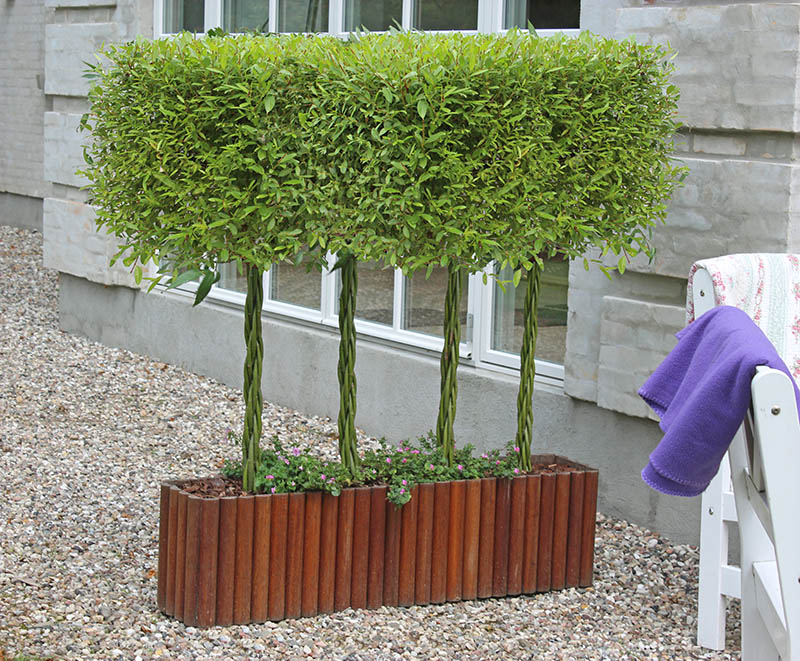
When purchased The Willow Wand® you need to keep the bottom of the wand moist by carrying it in a plastic bag. When you come home you put it in 10-15 cm water or you plant it straight away. You can keep it in water for 1-2 weeks or when the roots have grown to max 2 cm length.
No, The Willow Wand® is an outdoor plant. Willow is a deciduous species so the leaves will drop in Autumn and come back in Spring.
The Willow Wand® do not like to dry out so keep it moist. If it is planted in a pot you need to keep it moist, also in wintertime. If it is planted in the garden you only need to water in dry seasons.
To keep a compact crown, you trim at least twice in the growing season. It is recommended to trim in May and in August or when necessary, depending on the growing season. Do not trim in wintertime. You may trim it in early Spring to ensure the shape from start of Spring.
The Willow Wand® can stand hard frost.
The stem height of The Willow Wand® will never grow taller, it will only grow thicker. However, the crown can grow very big if you don’t trim it/shape it regularly.
If the willow tree is growing in a pot you will need to add fertilization after a few months from planting. Fertilize 1-2 times a year in the growing season with any normal compost/fertilization.
Yellow leaves may be a result of lack of water. Approximately 6-8 days after a ‘dry-out’ day the leaves will turn yellow and drop. It will start dropping from the inside of the crown. You can cut back the crown to make it burst with new shoots.
Willow is a deciduous tree, which will drop its leaves in Autumn and come back in Spring. If the leaves are dropping in the middle of the growing season it may be a result of lack of water. The Willow Wand® needs a lot of water and must be kept moist.
During the growing season you can trim it when necessary. If you trim it hard it will burst with lots of new shoots and become dense and compact.
If you scratch the bark and it is still green underneath, then it is still alive. Trim it hard and give it plenty of water and new sprouts will grow out. If the stem and the branches are all black and dry, the willow tree will not reshoot.
If you scratch the bark and it is still green underneath, then it is still alive. Trim it hard and give it plenty of water and new sprouts will grow out. If some of the twisted willow rods are black they will not grow again, but the rest of living willow rods in the twisted stem will still grow and create a beautiful crown.
The caterpillars may come from butterflies and you will need to remove all of them (they may only be visible at night). Afterwards, you trim the crown and new shoots can sprout.
It could be a fungal decease like you see on apple trees and roses (rust). Firstly, you remove the infected leaves and trim the tree. Secondly, you can spray the coming new leaves with any spray that prevents future fungal deceases.
It is the butterfly’s eggs which make the bubbles on the leaves. From the bubbles small green caterpillars will come and start to eat the leaves. To prevent this you can remove the bubbled leaves. Should the willow tree be infected already you can spray with bug spray.
The small buds along the stem must be rubbed off regularly to maintain the twisted look.
Ants can create a very airy soil which the willow roots do not like. The willow tree can stand any kind of homemade spray or ant killing spray or powder.